
Karst Forest (Hemlock)
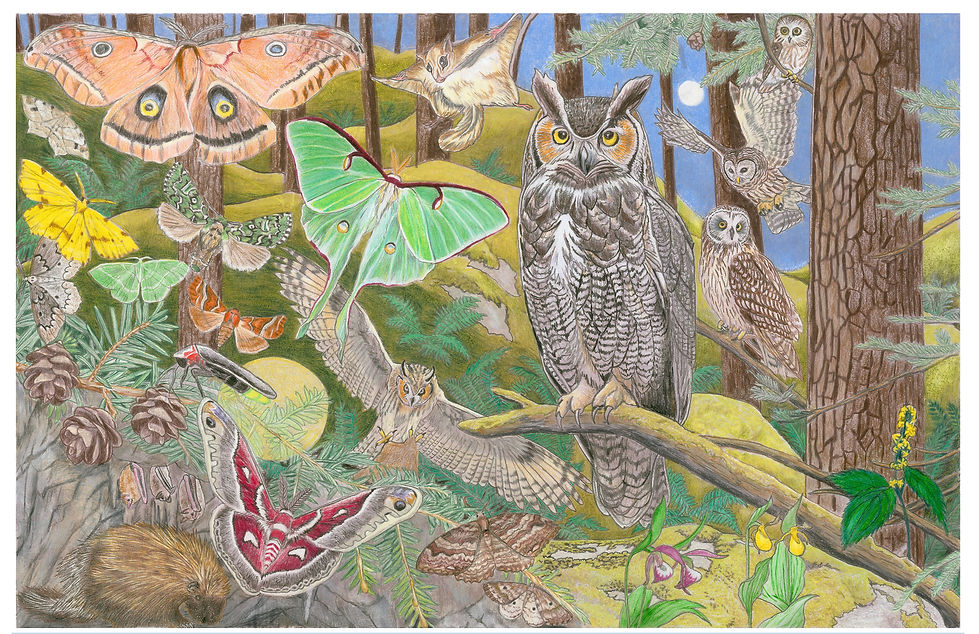

This illustration depicts an old-growth hemlock forest set atop unique karst topography. A firefly illuminates the nocturnal scene, revealing five owl species native to Nova Scotia, along with a variety of moths. Eastern Hemlock is the province’s longest-living and most shade-tolerant conifer. The ecosystem also supports many rare plants, including the Yellow Lady’s Slipper and the endangered Ram’s-head Lady’s Slipper.
As daylight fades over a Nova Scotia forest, a different community of wildlife becomes active. This nocturnal scene highlights some of the province’s most familiar nighttime inhabitants, from silent-flying owls and bats to the spectacular moths that emerge after dark.
The Great Horned Owl, the largest owl featured here, is a powerful predator of forests and woodland edges. It shares the night with the Barred Owl, whose distinctive call is often heard in mature forests, and the smaller Northern Saw-whet Owl, a secretive species associated with dense woodland.
Nova Scotia is also home to an impressive diversity of moths. Several of the province’s larger and more striking species are shown, including the enormous Cecropia Moth, Polyphemus Moth, Luna Moth, and Promethea Moth. Other colourful species include the Rosy Maple Moth, False Hemlock Looper, and White-fringed Emerald.
Karst landscapes provide a variety of specialized microhabitats that support unique biodiversity. Caves and underground passages serve as some of the province’s most important bat hibernacula, while Porcupines and other mammals may use caves, crevices, and rock fissures for shelter and denning. Smaller openings in karst formations are also used by reptiles and amphibians for overwintering. The calcium-rich soils associated with karst support an exceptional diversity of land snails and contribute to the presence of many rare and specialized plant species. Together, these features make karst forests among Nova Scotia’s most distinctive and biologically rich ecosystems.